
Laying the Cornerstone & Opening Our Doors
“When I came into the sanctuary,
I felt the holiness of the place.
All the prayers, tears, and love permeate this space.”
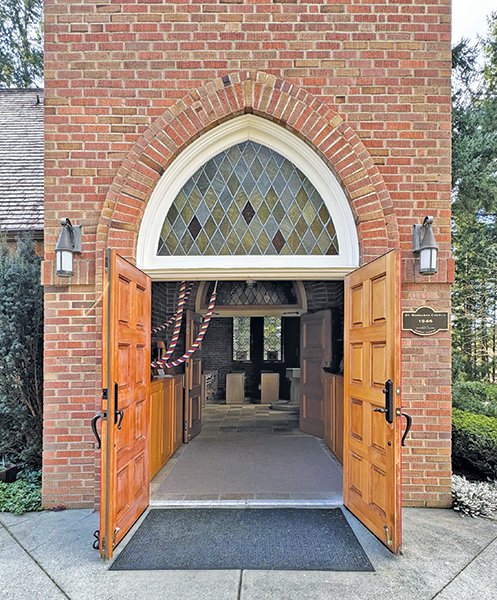
The parish of St. Barnabas Episcopal Church on Bainbridge Island began in 1922, when the Rev. Herbert Gowen led monthly prayer services in his home and later within Eagle Harbor Congregational Church. By 1945, it was recognized as an “unorganized mission.” On St. Barnabas Day in 1946, the cornerstone was laid on donated land. Just two years later, Bishop Bayne consecrated St. Barnabas as an established mission.
After nearly eighty years of worship, learning, and service in the same building, we are blessed with a healthy congregation, consisting of people coming from a wide variety of religious traditions. Our common desire is to experience God’s Love in a thoughtful, welcoming, and sacred space; through holy and beautiful worship, inspiring music, deep and challenging preaching, shared communion, and encouraging community.
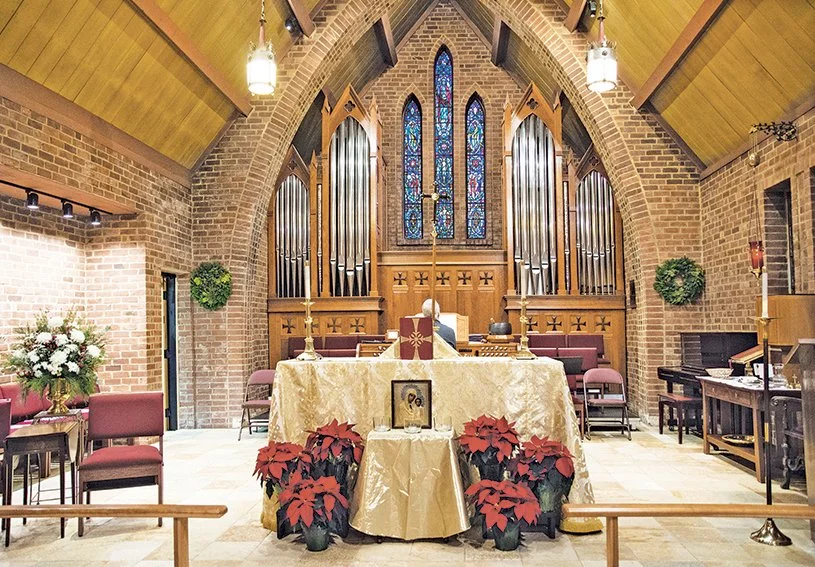
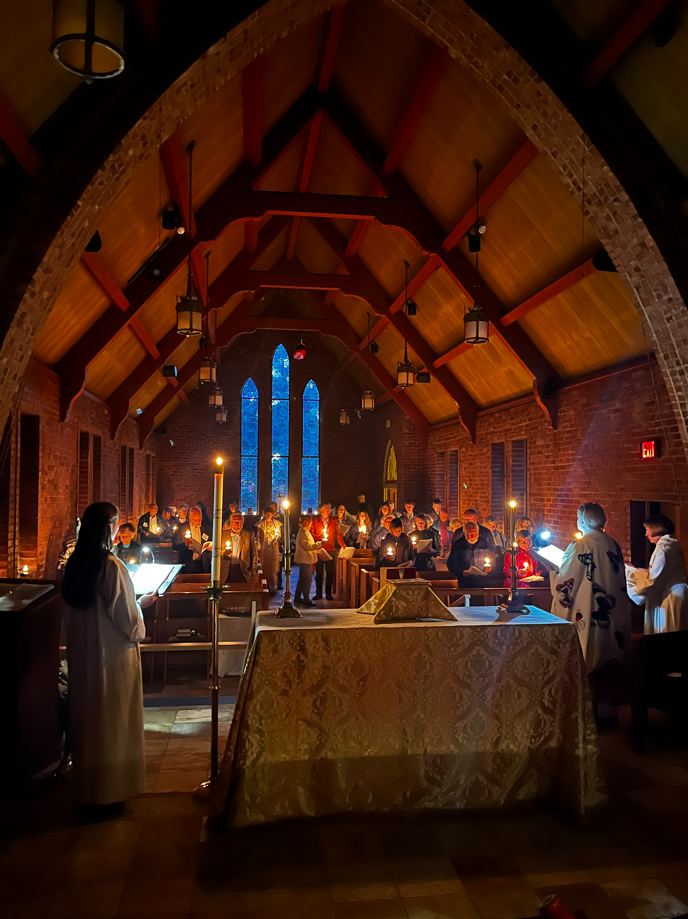
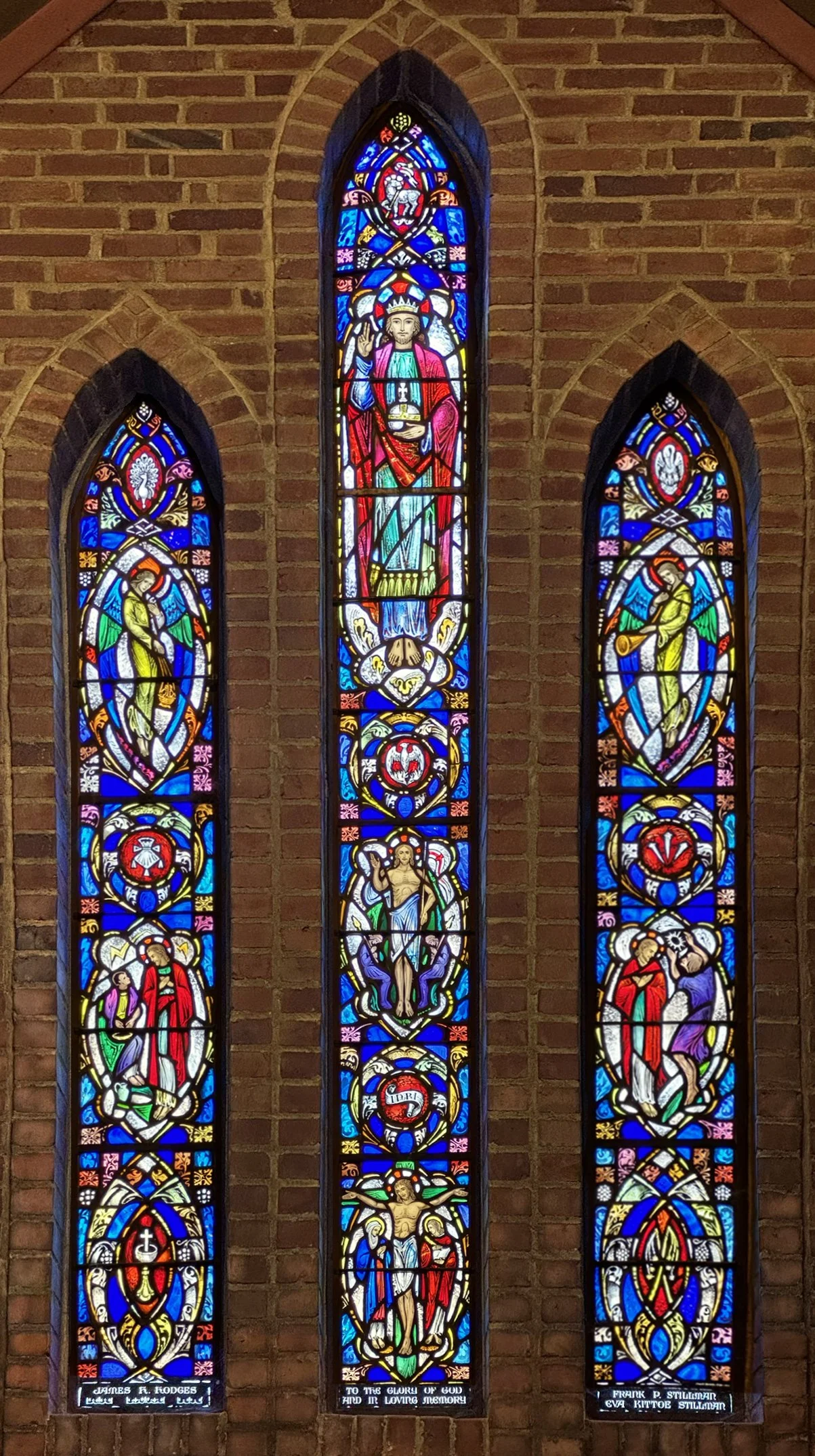
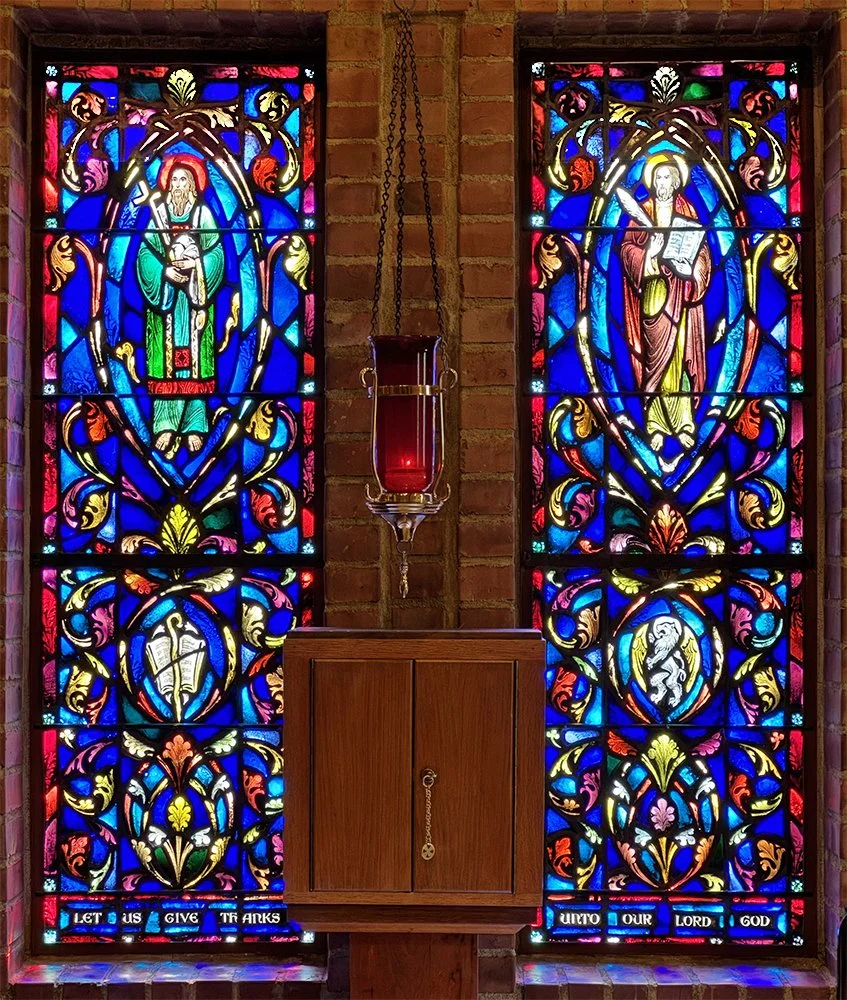
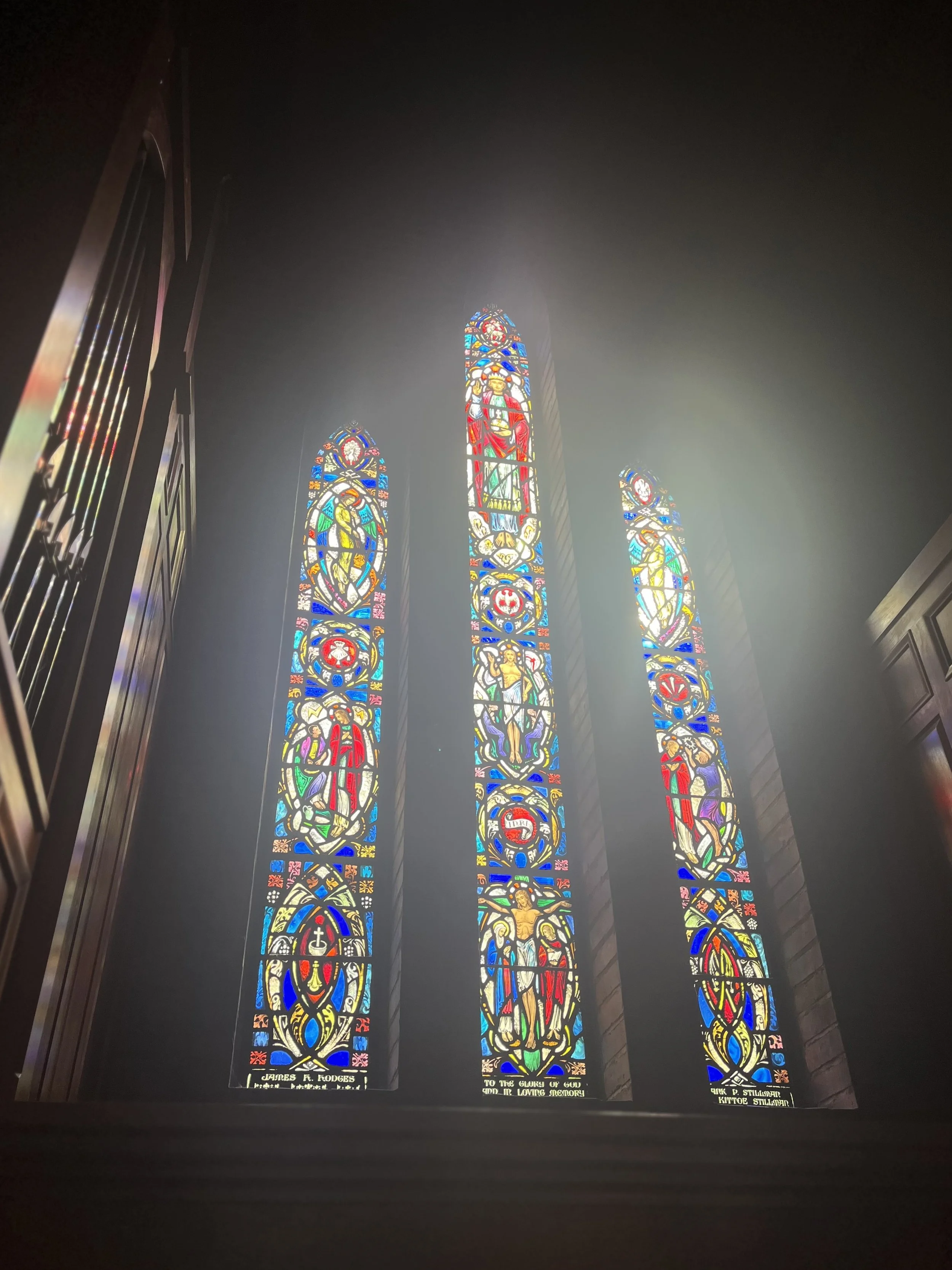
St. Barnabas has long been described affectionately as “too small for a cathedral and too large for a chapel.” The brick sanctuary is a recognized landmark on the island and a heartwarming example of an early Norman English style church, with a square bell tower, cedar shingle roof, slate floor, and high ceiling with pointed brick arches. Tripartite stained-glass windows, depicting the Passion of Christ, the Resurrection, and the Majesty, rise above the twenty-year old Bond pipe organ on eastern wall, behind the altar and the choir. Two more stained glass windows on the south side of the chancel depict St. Barnabas and St. Mark. The nave seats approximately 120 on oak pews, with pastel leaded windows along both sides and on the west wall, just above the Baptismal Font. Suspended from a beam, recalling our island’s shipbuilding heritage, is a small, hand-carved, red and black boat to remind us that we are shipmates on the vessel of the faithful, riding the waters of life together.
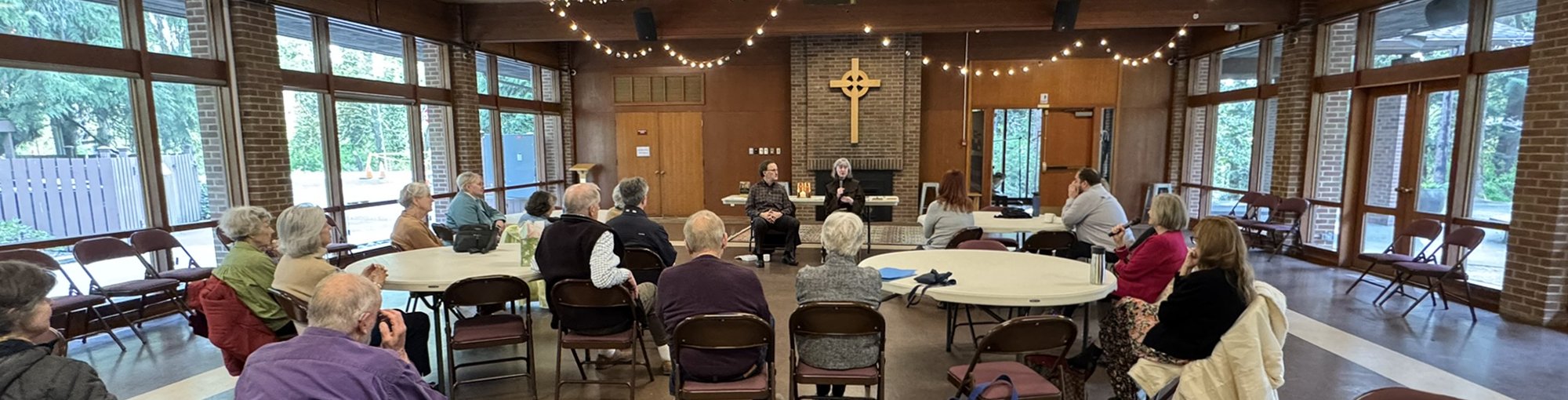
Our six–acre campus at the head of Eagle Harbor, is largely wooded, tranquil, and serene, and is part of the DNA of this congregation. In the 1960s, the congregation added a parish hall, with view windows and doors that open onto a courtyard, new labyrinth, and Douglas fir trees beyond. The hall and remodeled commercial kitchen serve as a welcoming venue for church and community events.
There are two other sacred places on our grounds. The interrium, where we inter ashes, is a tranquil spot for meditation and reflection. This contemplative spot allows members and family to meditate on their memories and ensures that those no longer with us are not forgotten. In the words of one thoughtful six–year–old, it’s “the remembering place.”
“The interrium is really important. People I know and love are out there providing a connection.
Just walking or sitting out there moves me.”
Links to Videos Showing Our Campus
Narthex, Nave, and Altar Sacristy and Robing Room Campus Exterior
Rector’s Officeand Parlor Day School Classrooms Library and Choir Room

The St. Barnabas campus—left, lower center—is located on six–acres of land on Bainbridge Island, Washington, near the head of Eagle Harbor.
For a timeline of our history, click here.
Land Acknowledgement
St. Barnabas Episcopal Church acknowledges that the land on which we gather is within the ancestral territory of the “People of Clear Salt Water,” the Suquamish People. Expert fishermen, canoe builders, and basket weavers, the Suquamish live in harmony with the lands and waterways along Washington’s Central Salish Sea as they have for thousands of years. Here, the Suquamish live and protect the land and waters of their ancestors for future generations as promised by the Point Elliot Treaty of 1855.
(Re)Learning Our History
St. Barnabas Episcopal Church has had a long–established interest in religious orders and more specifically, Franciscan spirituality. Inspired by St. Francis of Assisi, it is a way of life centered on following the Gospel through humility, poverty, joy, and a profound love of creation. It emphasizes seeing God’s presence in all things, fostering kinship with nature, and living in solidarity with the marginalized. Through this it sees the world as a manifestation of God’s love, leading to a deep respect for all creatures and nature.
As early as the 1970s and 80s, St. Barnabas parishioners have been engaged in a quest to find a way to live monastic spirituality in the world, inclusive of everyday people who have a wide range of backgrounds and stations in life.
Gloria Goller (religious name Mother, later Abbess, Gloria–Mary), originally a Third Order Franciscan, and others, had a vision for creating a contemplative religious order following in the footsteps of St. Clare of Assisi. She founded the Little Sisters of St. Clare in the 1990s and included other parishioners, eventually growing to include other women in the Diocese of Olympia who had a similar calling. This order continues to have a vibrant witness in our diocese and is a recognized religious community in the Episcopal Church. St. Barnabas was the home church of the community at that time, as well as when the community received canonical recognition by the Episcopal House of Bishops.
In June 2026, we are anticipating that another parishioner, Laura Carroll, will be taking life profession vows with the Community of Francis and Clare. Sally Sulonen (religious name Sr. Mary–Louise) was one of the first sisters in the community. She served as the longtime formation director. Marion Lofgren (religious name Sr. Marion–Hilda) was another early sister and a St. Barnabas parishioner. Parishioner Grace Grant (religious name Sr. Grace–Teresa) became a sister in 2014 after she and her husband, Rev. Dennis Tierney, came to St. Barnabas. Sr. Grace created the formation curriculum used by the community. Fr. Dennis was the Chaplain for Little Sisters of St. Clare during that period.
Other parishioners living under Franciscan vows include members of the Third Order, Society of St. Francis. One notable member was the late Marilyn Brandenburg, who also served for a number of years as our deacon at St. Barnabas, and was a strong advocate for pastoral care to incarcerated women at the correctional facility in Purdy, Washington. Another is Priest Among Us The Rev. Steve Best, who is presently serving our community.
Please feel free to contact The Rev. Steve Best or Laura Carroll for further information.
Contact Steve Best or Laura Carroll
About Our Stained Glass
The stained glass in St. Barnabas was created by the preeminent Boston firm, Charles J. Connick Studio, founded in 1913. Connick was often called America’s visionary stained glass artist who worked to assist in the revival of this medieval craft, successfully persuading twentieth century Americans that this form of artistry could inspire powerful and expressive modern stained glass artwork. Influenced by the Arts and Crafts movement, his studio embodied the ideal that the art was produced by a community of committed craftsmen.
He preferred to use clear “antique” glass, similar to what was used in the Middle Ages to attain the color intensity and “dancing light,” staggering the joint leading and bars to help with this effect. His windows are in buildings which include the cathedrals of St. John the Divine and St. Patrick’s, New York City; St. James Cathedral, Seattle; Grace Cathedral, San Francisco; the Princeton University Chapel; and the Heinz Memorial Chapel, University of Pittsburgh—considered his most important achievement with its over 4,000 square feet of windows.
After his death in 1945, ownership of the firm reverted to his employees and was renamed Charles J. Connick Associates, which then closed in the late 1980s. The five Connick windows in St. Barnabas were designed and created by Charles J. Connick Associates.
The softly colored pastel stained glass windows in the remainder of the church were produced by the Nyson Glass Company, a Seattle company making glass in the Arts and Crafts style for use in business and churches from the 1920s to 1950s.
Window Specifics
The center lancet window located in the chancel is “…dominated by a representation of Christ the King, with the heavenly crown. He wears a red mantle, the color of divine love, and in His left hand holds the orb surmounted by the cross, signifying His dominion over the world. His right hand is raised in blessing.
“At either side are an Angel of Prayer with censer (left), and an Angel of Praise with trumpet (right).
“The medallions below symbolize (in the left panel) Christ before Pilate; (in the right panel) the Crowning of Thorns. The lower medallion of the center lancet sets forth the Crucifixion, with the accompanying figures of the Blessed Mother and Saint John the Evangelist. Above is the Resurrection.
“The growing vine form throughout the background outlines and defines the medallions as well as the small, well–known symbols which occur at intervals. These are as follows: Lower left lancet, the Chalice and Cross (Gethsemane); The Money Bag, above the medallion devoted to Christ before Pilate; lower right lancet, The Scourge; above the three Nails; Upper left panel, the Peacock, symbol of the Resurrection and Immortality; and upper right, the Pelican feeding its Young with its own Blood. Above the Crucifixion medallion appear the letters INRI; above the Resurrection panel, The Phoenix rising from the Ashes; and in the lofty position at the top of the center lancet, the Lamb of God with the banner of victory.”
To view the original work order for the three chancel windows, click here.
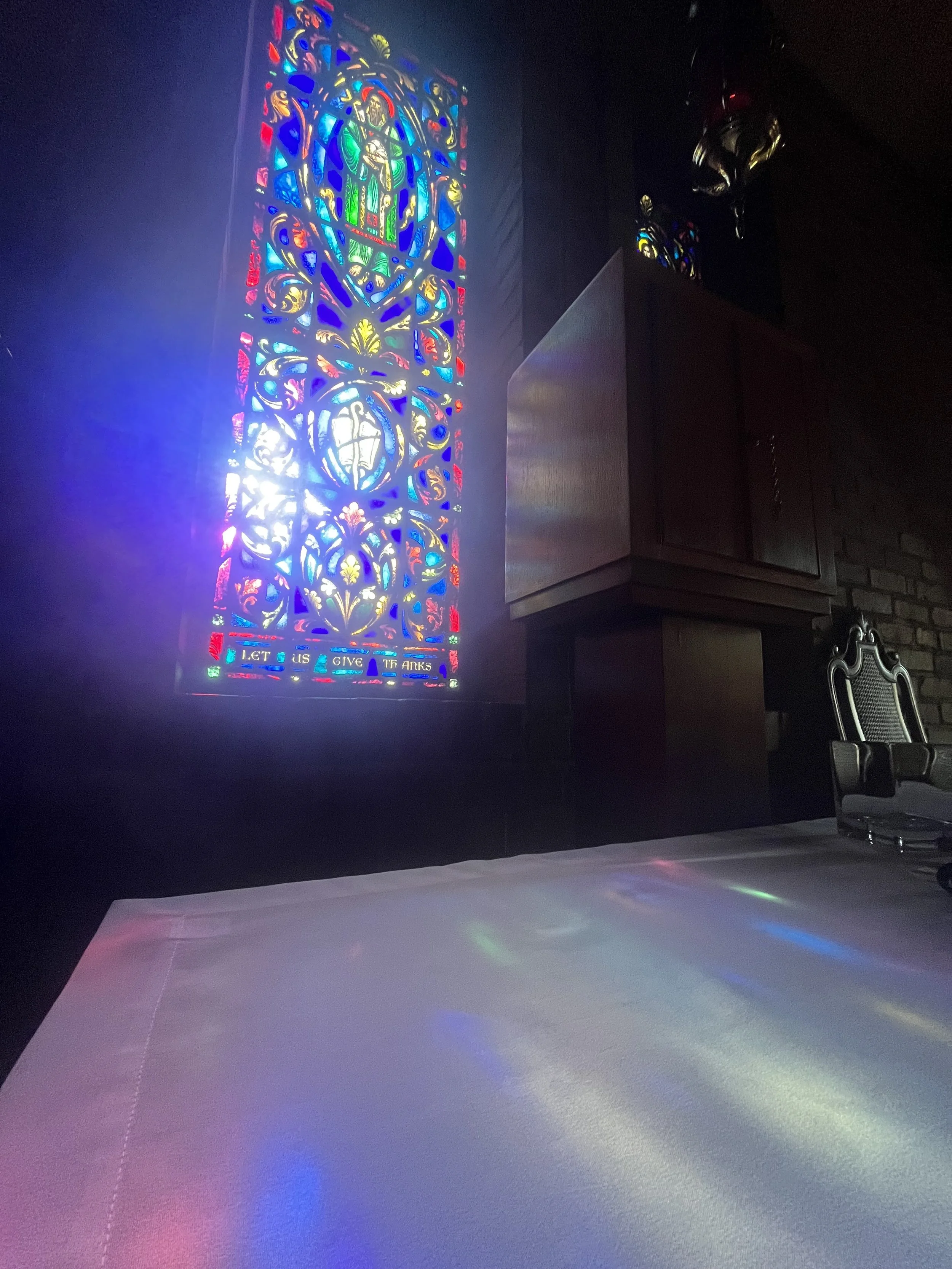
The windows on the south side of the church were added in June 1951, after it was realized that too much light was coming into the altar area, making it difficult for the organist to read music. The windows were requested “to be in similar colors but with the color kept deep and full[er]” than the chancel windows, and show representations of St. Barnabas and St. Mark.
The response from Connick Studio notes, “In his enthusiasm, the designer has gone a little further than we planned, including other symbols of both Saint Barnabas and Saint Mark at the bases—the open book and pilgrim’s staff for Saint Barnabas, and Saint Mark’s evangelical symbol, the winged lion. If you would rather not have these, the space could readily be designed in the conventional foliage.”
Reader, they kept the additional symbols and you can view them above, as well as on your next visit to the sanctuary.
To view the original work order for the two south windows, click here.